Research

Below, are quick summaries of a few project I'm currently working on. A complete list of my publications can be found here.

100k Galaxy Models from the COSMOS-ACS Data
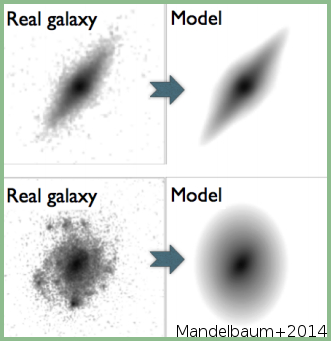
The miniscule distortion of galaxy shapes due to weak gravitational lensing is one of the best cosmological tools for characterizing dark matter halos and memeasuring the expansion history of the universe. The GREAT3 challenge was designed to test techniques for measuring this distortion, using the observed distribution of galaxy shapes. For my part in this work, I fit parametric models to over 100,000 real galaxy from Hubble Space Telescope data using code I developed as a part of my thesis. The parametric models are available here.
Finding Double Yolk Galaxies (Mergers)

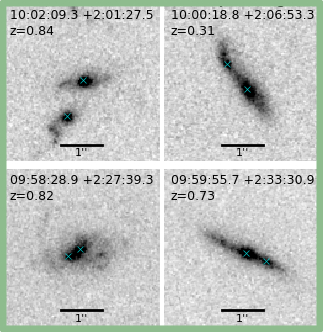
While dark matter simulations tell us the universe grows hierarchically (big things are made up of smaller things), catching two galaxies in the act of merging is rare. To date, many studies select galaxy mergers by hand. I developed an automated filtering method to select and classify systems with two distinct peaks, or two galaxy centers in the process of merging. By testing this method on simulated data, we measure the rate of false positives and negatives. These are used to accuratley calculate the total merger rate as a function of time.

Brightest Cluster Galaxies in MaNGA

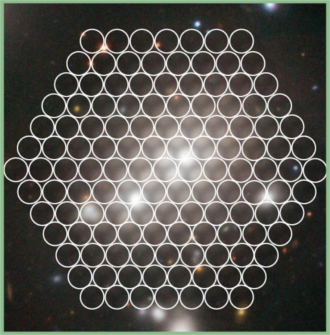
One of the most exciting new techniques in observational astronomy is multi-object IFU spectroscopy, in which many, spatially resolved spectra are obtained for many objects all at once. The MaNGA survey on SDSS is such a project. I led a successful ancillary proposal to use the MaNGA spectrograph to observe the brightest galaxies in the centers of rare, massive galaxy clusters. We plan to combine the resolved spectroscopy from MaNGA with weak lensing observations from imaging. Together, these will tell us how the dark matter and stars in BCGs affect one another.